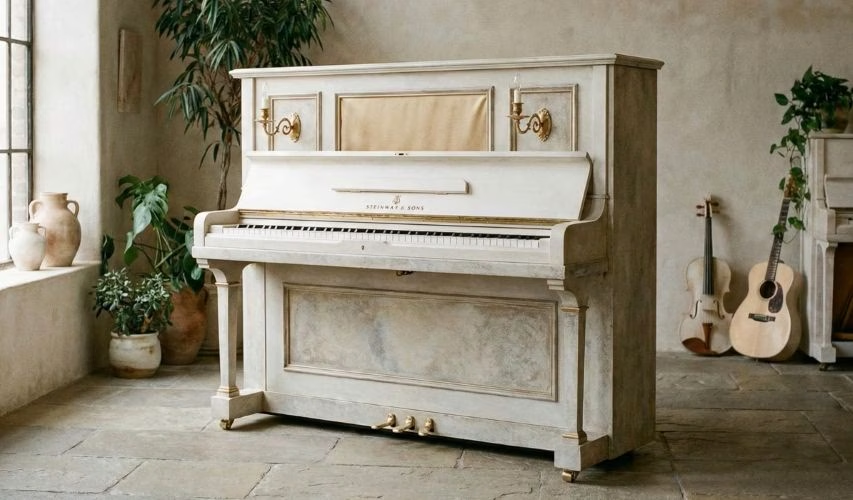
Why Choose Private Piano Coaching?
Finding the right piano teacher in Singapore is the difference between simply hitting notes and making music. While many schools place students in shared group classes, KGMA specializes in private piano lessons that ensure every minute is dedicated to your hand posture, articulation, and musical expression.
The 1-on-1 Advantage: In a group setting, subtle bad habits like collapsing knuckles or stiff wrists often go unnoticed, leading to technical ceilings later on. At KGMA, we focus intensely on ergonomic technique from day one. Whether you are seeking kids piano lessons to build a strong classical foundation or adult piano classes to learn pop songs for leisure, our studios are equipped with high-quality upright and grand pianos for an authentic touch.
Curriculum Tailored For Every Age
Private piano lessons at KGMA serve children from age 4, teenagers preparing for ABRSM or DSA, and adults starting or returning to the keys. Every student follows a 1-to-1 plan covering classical technique, pop chords, and exam pathways when they want them.
Piano Lessons for Children
Perfect Pitch & Foundation
The "Junior Keys" program leverages the critical window for developing perfect pitch. We focus on hand shape (the 'claw'), finger independence, and reading the Grand Staff through engaging, colorful methods.
The Hybrid Advantage
We blend rigorous ABRSM technique with Disney and Pop favorites. This keeps motivation high while building a serious classical foundation.
Phase 1: The Hand Arch
Building the imaginary 'ball' in the hand to prevent collapsing knuckles.
Phase 2: Note Reading
Navigating Middle C and reading simple patterns on the Treble Clef.
Phase 3: Hands Together
The magic moment. Coordinating Left and Right hands for the first time.
Phase 4: Rhythm & Pulse
Counting out loud while playing. Keeping a steady internal beat.
Piano Lessons for Teenagers
DSA, Exams & Pop Style
Whether aiming for Direct School Admission (DSA) via music or simply wanting to play in a church band, we provide the tools. Fast-track ABRSM grades or dive deep into chords and improvisation.
The Hybrid Advantage
We respect the academic load teens face. Our approach balances exam pieces with the songs they actually listen to—from Anime OSTs to Top 40 Pop.
Phase 1: Scale Velocity
Developing speed and evenness in scales and arpeggios.
Phase 2: Chord Theory
Understanding I-IV-V progressions to play pop songs by ear.
Phase 3: Sight Reading
Reading new music fluently for exams or band rehearsals.
Phase 4: Interpretation
Adding dynamics, rubato, and pedal for emotional expression.
Piano Lessons for Adults
Stress Relief & Sophistication
Always wanted to play "River Flows in You"? It's never too late. We specialize in adult beginners, offering a judgment-free zone to decompress after work and learn the music you love.
The Hybrid Advantage
We use your adult analytical skills to teach theory faster, allowing you to bypass years of children's drills and start playing real songs sooner.
Phase 1: Keyboard Geography
Understanding the layout of the keys and basic note names.
Phase 2: Chords & Harmony
Learning major and minor chords to play accompaniment.
Phase 3: Independence
Getting the Left Hand to do something different from the Right.
Phase 4: Repertoire
Building a setlist of 3-5 songs you can play for friends or yourself.
Build a Solid Foundation
We don't just teach songs; we teach musicianship.
Posture & Hand Shape
Developing the correct arch, wrist flexibility, and arm weight transfer for a rich, singing tone.
Reading & Rhythm
Mastering the Grand Staff, sight-reading fluency, and internalizing rhythm for steady performance.
Technique & Harmony
Scales, arpeggios, and understanding chords. Moving beyond reading to understanding the music.
Musicality
Dynamics, phrasing, pedaling, and emotional expression. Bringing the notes to life.
Leisure Playing
The Casual Route
Zero pressure. Focus on learning your favorite songs, playing by ear, and unwinding at the keys.
Pop & Jazz
The Modern Route
Chord progressions, lead sheets, improvisation, and playing in a band setting.
Classical Mastery
The Academic Route
Virtuosic technique, sight-reading, and rigorous preparation for ABRSM/Trinity graded exams.
Why We Are Different
Standard schools teach books. We teach musicianship.
The Plateau Breaker
Hit a wall? Select your frustration to see the KGMA solution.
"Push harder and practice more scales."
"We adjust your arm weight and seating height to eliminate tension instantly."
The Syllabus Builder
Build your dream curriculum. Click tags to add them to your plan.
Find Your Piano Path
Every pianist is unique. Let's find out what your journey looks like.
1. What is your current experience level?
Did You Know? The Science of Piano
Tap the cards to discover the hidden benefits.
Brain Power
Tap to Reveal
Dexterity
Tap to Reveal
Neuroplasticity
Tap to Reveal
Emotional Release
Tap to Reveal
Your Piano Faculty
Dedicated Specialists
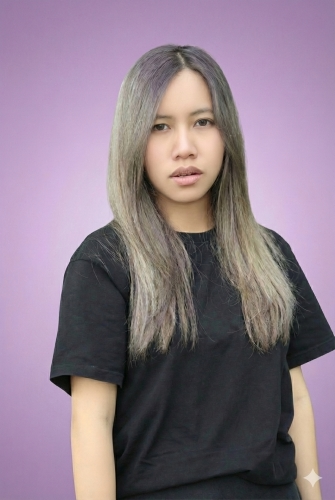
Chanel
Professional Accompaniment

Jean Kai
Senior Piano Coach
Piano Lesson Rates
Transparent pricing. No hidden costs.
Standard Curriculum
Jean Kai
Professional Accompaniment
Chanel
- Exam Accompaniment
- Advanced Aural Training
- Performance Preparation
Limited Availability
Additional One-Time Fees
*Deposit is fully refundable with 30 days official notice.
Piano Guides & Next Steps
Private piano lessons for kids, teens and adults in Singapore — with clear fees and exam pathways.
Lesson Fees
Transparent monthly rates and trial pricing for private piano classes.
HDB Digital Piano
88-key weighted practice that neighbours will actually tolerate.
First Piano Lesson
What to bring, nails, and how the first hour at KGMA actually runs.
Pop Piano
Chords and songs first — exams only if you actually want the paper.
2026 Price Guide
What piano lessons cost in Singapore and how to compare value.
KGMA Journal
More piano practice tips, exam advice, and parent guides.
Frequently Asked Questions
Do I need a real acoustic piano to start?
For the first 6 months (Beginner/Grade 1), a weighted-key digital piano (88 keys) is sufficient. However, as students progress to Grade 3 and above, we highly recommend an acoustic upright piano to develop proper finger strength, dynamics, and tonal control. We can advise on rental or purchase options.
How long does it take to reach Grade 8 Piano?
The journey to ABRSM Grade 8 typically takes 6-8 years depending on the starting age and practice discipline. Our private coaching curriculum focuses on efficiency, often helping dedicated students shave 1-2 years off the standard timeline.
What is the best age to start piano lessons?
We accept students as young as 4 years old for our 'Junior Keys' program, which focuses on aural skills and hand shape. 5-7 years old is generally considered the 'golden window' for starting formal piano education to develop perfect pitch.
Do you teach Pop songs or just Classical?
We teach both! While we use Classical techniques (ABRSM) to build a strong foundation, we strongly encourage students to learn Pop chords, Jazz improvisation, and contemporary songs to keep the passion for music alive.