The 80/20 Rule in Drumming
Stop practicing everything. Start practicing what matters. How the Pareto Principle can unlock your rhythm.
By Chua Chun Leng
The Vital Few
In drumming, 80% of your success on a gig comes from 20% of your vocabulary.
- Solid Timekeeping (Pocket)
- Dynamic Control
- Core Rudiments (Singles, Doubles, Paradiddles)
Time > Chops
A simple beat played with perfect time gets you hired. A complex fill played out of time gets you fired.
The Big Three
Single strokes, Double strokes, and Paradiddles make up 90% of all drum fills if you analyze the sticking.
Groove & Feel
Making the audience dance is the goal. Technicality is only useful if it serves the music.
Want the full breakdown of how to structure your practice?
Imagine walking into a practice room. You sit down behind the kit, sticks in hand, and for the next two hours, you play everything you know. You run through that complex linear fill you saw on Instagram. You try to play as fast as you can. You fiddle with your snare tuning for 20 minutes.
You walk out sweating, feeling like you "worked hard." But a week later, your playing hasn’t actually improved. Why?
This is the classic trap of quantity over quality. In the world of economics, there is a concept called the Pareto Principle, more commonly known as the 80/20 Rule. It states that roughly 80% of effects come from 20% of the causes.
When applied to drumming, this principle is revolutionary. It suggests that 80% of your results—your sound, your hireability, your groove—come from only 20% of your skills. The secret to becoming a master drummer isn't learning everything; it's mastering the vital few things that matter most.

Figure 1: Visualizing the "Vital Few" components of the kit.
Identifying the Vital 20%
Drumming is an infinite game. You could study Afro-Cuban polyrhythms, Indian Konnakol, heavy metal blast beats, and jazz brushes for a lifetime and still not scratch the surface. If you try to practice everything, you will master nothing. To apply the 80/20 rule, we must identify the pillars that support almost every genre of music.
1. Timekeeping (The Holy Grail)
This is the non-negotiable. If you have amazing chops but your tempo fluctuates, you cannot function as a drummer. The drummer's primary job is to be the metronome for the band.
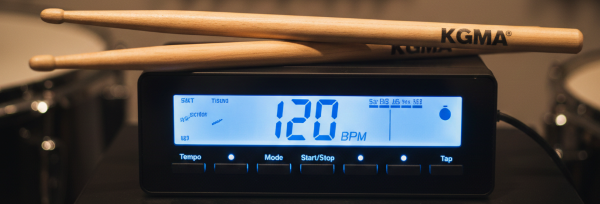
The 80/20 Application: Spend the majority of your time practicing with a click track. Focus on the space between the notes. A simple 4/4 beat played with impeccable time is infinitely more valuable than a sloppy solo.
2. The "Big Three" Rudiments
There are 40 standard drum rudiments. Learning all 40 is a noble goal, but it falls into the "trivial many" category for most beginners and intermediates. If you analyze the drumming of legends like Steve Gadd, Vinnie Colaiuta, or Travis Barker, you will find that 90% of their fills are variations of just three stickings:
- Single Strokes (RLRL): For speed and power around the kit.
- Double Strokes (RRLL): For smooth rolls and ghost notes.
- Paradiddles (RLRR LRLL): The key to changing direction and moving between drums.
3. Dynamic Control
Amateurs play at one volume: loud. Professionals utilize the full dynamic range. The ability to play a ghost note (very quiet) right next to an accent (very loud) creates the "groove" or "pocket" that makes people want to dance. This nuance is part of the vital 20% that separates good drummers from great ones.

The "Trivial Many" (The Distractions)
The "Trivial Many" aren't necessarily bad things—they are just things that yield diminishing returns. They are the 80% of activities that only contribute to 20% of your success.
Excessive Gear Obsession
Buying a $800 snare drum won't fix your time feel. Changing heads every week won't improve your double strokes. Gear is fun, but it's often a form of procrastination.
Complex Linear Fills
Those "gospel chops" fills you see on Instagram are impressive, but they rarely fit in a standard rock, pop, or worship song. Practice them for fun, but don't prioritize them over the groove.
The Optimized Practice Routine
How do we translate this philosophy into a 60-minute practice session? We ruthlessly cut the fluff. Here is a sample "Pareto Protocol" for drummers:
| Time Segment | Activity | The Goal (The 20%) |
|---|---|---|
| 00:00 - 00:10 | Warm-up & Hand Technique | Singles & Doubles on a pad. Focus on evenness, not just speed. |
| 00:10 - 00:30 | Groove & Timekeeping | Playing a simple beat to a click. Record yourself. Is it locked in? |
| 00:30 - 00:50 | Coordination / Independence | Learning a new limb combination. This expands your vocabulary. |
| 00:50 - 01:00 | Free Play / Fun | Apply what you learned musically. Keep the passion alive. |
Conclusion: Do Less, Achieve More
The 80/20 rule is not about being lazy. It is about being strategic. It is about recognizing that time is your most limited resource. By identifying the core skills that generate the most musical impact—Time, Groove, and Basic Rudiments—you can accelerate your growth faster than someone who practices twice as long but with half the focus.
Next time you sit at the throne, ask yourself: "Is what I am doing right now part of the Vital 20%? Or am I just making noise?"
Master Your 20% at KGMA
Struggling to identify your weaknesses? Our instructors specialize in building optimized practice routines tailored to your goals.
Book a Trial Lesson